Showing posts with label USTA rules. Show all posts

Thursday, November 10, 2016

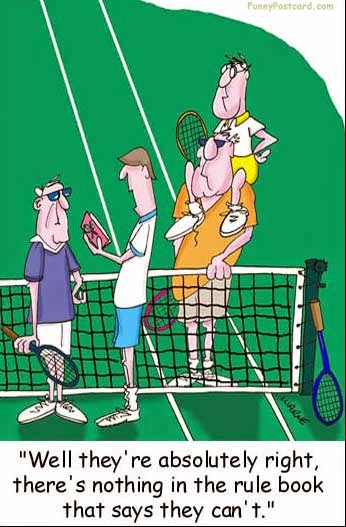
Weird tennis rules & match scenarios - Part 2

Kristianne Bontempo & Katelyn Caniford | Towpath Tennis Contributors

How many times have you played a match and wondered, “Is that legal?” Well with all sorts of odd-ball rules and strange scenarios, you might find yourself frequently questioning the rules. We’re here to give you a list of ten uncommon situations you might find yourself dealing with during your matches.

1) I was playing a match one time and I hit a shot that was floating in the air, but looked like it wasn’t going to go over the net. As the ball was floating, my opponent reached over the net and hit the ball. Is that allowed?  No it’s not allowed. The ball must cross onto HER side of the net before she makes contact, and as long as she did not touch the net, THEN it is okay to follow-through over the net. The only situation when a player may reach over the net to play a ball, is if the spin or wind brings the ball back over the net to the side of the player(s) who hit the shot. Then your opponent can reach over the net to hit the ball.

2) I once played a match where my opponent was cracking open a new beer every so often while changing sides. Are you allowed to have alcoholic beverages during a USTA match? Surprisingly we cannot find any rule against this, but we would hope players would wait at least until after the match is completed to consume any alcohol. If the facility prohibits alcoholic beverages on the court then that player should certainly abide by their rules.

3) Is there a limit to how many lets you can serve in a match? Someone once tried to call a fault for doing so. No! Serve as many times as you need☺

4) Is there a rule that prevents the receiver from “crowding” the service box when returning serve? You and your partner can stand anywhere you want on your side of the court BUT seriously why would you want to considering 1) You can be distracting your doubles partner who’s returning. 2) You can get hit by your opponent's serve and lose the point anyways. 3) You need to let the service ball bounce before you hit it. 4) Your opponents could claim a distraction if you look like you’re intentionally distracting them.

5) I played a doubles match one time where my shot fell too short while lobbing and I told my partner to “watch out.” We ended up winning the point. However, my opponents told me I cannot talk when the ball is leaving my racket and that we can only talk when the ball is coming towards us. Is this correct?
No, this is not correct. You are allowed to speak to your partner at any time during play. Just try to be respectful about it. For example, this could become an issue if you and your partner are so loud that it affects your opponents' concentration or ability to set up the point. They in turn are allowed to ask for a let. 

6) During a singles match, your opponent’s hat flies off in the middle of the point. Is it considered a let or a loss point? In an officiated match, a hat, glasses, ball or racket that falls during a point is considered a let. If an item falls again, then there will be a loss of point. HOWEVER, in an UN-officiated match it is up to the opponent (not the player who dropped the item), to call the let. Also, if the ball in play happens to touch anything that you wear or carry (other than the racket) or any part of your body, then you lose the point.

7) If you whiff a serve, is it considered a fault? Yep sorry! Good news is if you swing and miss an overhead (or any other shot for that matter), you can try to retrieve the ball after the permitted one bounce or no bounce and that is legal. Your partner can make an attempt to play the ball if you whiff a shot as well.

8) What happens if my opponent is serving and purposefully comes to the baseline every time with only one ball? Therefore if she misses, she can take her time walking to get another ball in order to delay. The official rules state that if the first serve is missed, then the second serve should then be hit without delay. Even though the rules also state that there is a 20 second provision in between points, that doesn’t apply to first and second serves. Your opponent should have two balls with them every time they step up to serve.

9) Can you switch hands when playing tennis? There are players that are ambidextrous that can play with two forehands/two backhands (ie. Monica Seles). It might screw with your opponent's head but yes, it is legal to switch racket “handed-ness” during play.

10) I once hit a shot that was clearly going out. Both my opponent and I know it, yet he calls the ball out but then reaches up and catches it. Is this allowed? No. According to the rules, if a player catches a ball before it bounces then that player automatically loses the point. Players are always considered to have the benefit of the doubt that the ball is in, until it touches the ground.

To study up on other weird tennis rulings, check out Miscellaneous USTA Rules. You never know when you're going to need it!

Do you have a question or weird scenario that you'd like to know the ruling of? Email us with your question!

Wednesday, April 8, 2015

Weird tennis rules and match scenarios

Kristianne Bontempo | Towpath Tennis Employee | Online Store Manager

Have you ever been in a middle of a match when something so off the wall happens where both you and your opponent wonder, how do we rule this? Well we've experienced a handful of these odd-ball scenarios and have the USTA sanctioned rulings on each of them to keep you on your toes and to make you into an on-court know-it-all!
  1. What if somebody serves out of order? If you realize a doubles team had served out of order after the fact, then the match continues on in the corrected original rotation of servers. If you make this discovery during a game then immediately stop play and make the correction, then continue the game as is. Regardless of who was serving, all completed points stand as played previous to the discovery. 
  2. What if the ball bounces back over the net before I could hit it? If the spin or wind brings the ball back over the net, then you must hit the ball in order to win the point even if that means reaching over the net to put the shot away. If you fail to touch the ball, then the player who hit the spin shot wins the point. Just be careful not to touch the net or your opponent's side of the court or you lose the point!
  3. What if the ball falls out of my pocket/skirt, do I lose the point? Not necessarily. In regular match-play without tournament officials, it is up to the opponent to call the hindrance and play a let (not you). The call has to be made immediately though, not after the point is played out. If an umpire is present, they will always call a let first. If a ball repeatedly falls out of your pocket, then you may lose a point over the hindrance.
  4. What if the ball hits my racquet twice? As long as you are hitting the ball twice on the same swing or follow-through, it is then (and only then) considered legal. 
  5. What if my strings break on a serve, is that a let? If your strings break during a serve or any other time during a point, it is not a let for anybody. Even if it makes a funny and distracting noise, plan to play out the point even with a hole in your racquet. 
  6. What if the opponent calls a ball of mine Out before it hits the ground, but then yells Good and tries to continue playing out the point? If an Out call was made (and not in the sense of communicating to a partner) then play has stopped. So in this case your opponent would lose the point. And that is exactly why you wait to make a call until after the ball bounces. 
  7. What if you're playing on a court with a dividing net/wall/fence, can you call a Let if the ball hits any of these objects before you hit the ball? Sorry but if all players agree to play on the court as is, all players are agreeing to it's possible hindrances. 
  8. What if an opponent calls a Let on a ball that doesn't actually roll onto our court? Any ball in a player's vision, whether on the other side of the net or near the sidelines, may hinder play during a point so a let is permitted. As long as the let is called prior to the completed point (or before the one calling the let hits the ball), it is considered valid. 
  9. What if I was returning serve when my doubles partner (who was no where near the service box) got clipped on the toe by the server before it bounced. Who gets the point? A ball that hits any part of your body or clothing on you or your partner (on and off the court), is considered a point won by the other team. This is also true if the ball hits any part of you other than your racquet and bounces back over the net. The point is still your opponents-sorry you got hit!   
  10. What if my opponent hits a volley but his racquet swings over the net, isn't that my point?  As long as he hit the ball before his racquet swung over the net, the shot is considered legal. This can be a hard one to judge unless he's clearly reaching over the net to put the shot away.
To study up on other weird tennis rulings, check out Miscellaneous USTA Rules. You never know when you're going to need it!

Do you have a question or weird scenario that you'd like to know the ruling of? Email us with your question!
*Follow us on Facebook to get a first look at new posts, pictures and on-going events or visit us at towpathtennisshop.com and check out the latest arrivals in the shop!

Monday, February 24, 2014

When to call a foot fault

Kristianne Bontempo | Towpath Tennis Employee | Online Shop Manager

Call a foot fault if you see one clear as day.
The foot fault is probably the most dreaded call to make. Sure you have every right to call one if you see an infringement clear as day, however this one little call can open up a whole can of worms because intentional or not you're basically calling your opponent a cheater. Serena Williams was fined $175,000 and ruined any chance at winning the US Open in 2009 by going absolutely bizerk on a line judge who called a foot fault on her. So at the end of the day, is the call worth the trouble?

Whether we're having a friendly match or battling it out during an intense tournament, there's a time when we're going to be faced with the dilemma of making the difficult (and painfully awkward) call that your opponent has foot faulted. Even though you should never ignore when an opponent is foot faulting, we do believe there's a time and place on when you should make it known. 

When should you let it slide? If you're playing recreationally or if during a match you see a one-time offender, it's a little silly to get everyone worked up over a call that might not make a huge difference in the end result. Unless you're a disliked stickler for the rules, get over it and move on. 

So when should you call a foot fault? Anytime you're playing in a competitive match players are encouraged to make a foot fault call as they see warranted, but it's entirely up to you to make. If you're unsure, we recommend following these guidelines based off of the USTA code of conduct:

  • Begin with a warning. On court blood can be easily washed away with a friendly warning to a foot faulting offender. 
  • Make the call when and only when you see an unavoidable flagrant foot fault. It's hard to tell from across the court if your opponent is just crossing the baseline, however it's a whole other story if they appear to be going for a new long jump record. 
  • If your opponent gets defensive (which more often than not is the case), remind them of the rule and if needed request back-up whether that's your doubles partner, a coach/captain, or if you have access to one an official. 
The thing about foot faults is they're inevitable, but mental meltdowns don't have to be. So choose your battles and don't allow it to dictate your game. The same thing stands if you're the one getting called on a foot fault. Back up a few inches and don't change a thing! 

*Follow us on Facebook to get a first look at new posts, pictures and on-going events or visit us at towpathtennisshop.com and check out the latest arrivals in the shop!

Thursday, August 8, 2013

How to play with a tournament official

Kristianne Bontempo | Towpath Tennis Employee | Online Shop Manager 


We've had another successful year at the Akron Open thanks to all the players and volunteers who participated. We had quite a few exciting matches filled with fist pumps, dives, and un-returnable winners. However, despite having the majority of our matches running with not so much of a hiccup, there were some courts that had a little different outcome. There were questions on scores, tiebreakers, and rulings from double bounces, foot faults, to nicking a ball in the air.  Luckily there's always a tournament official on hand to settle any disputes but we'd like to review how to utilize an official and what to do when there isn't one around. 
 
All USTA sanctioned tournaments will have a roaming official, meaning they will move from court to court and assist when needed. However, what many players don't realize is that when you have an official on your court and you're hoping for an overrule on a call or a clarification on a rule, you have to request for one. So if you're wondering about a line call that your opponent called out, ask the official what they saw.
 
On the other hand, if you're in the middle of a match and you have a discrepancy or question when the official is nowhere nearby, what do you do? Two things, stop play and signal for a spectator to get an official or wait on the court until one comes around. If you decide to play on after openly questioning the call, warn your opponent that you will be requesting an official to overlook the match.
 
Remember, playing a match with an official on your court is actually a good thing--unless of course if you're knowingly cheating. An indication in the quality of any tournament is if there is an official around keeping order on the courts. Imagine them as a supportive teammate and if they make an overrule or call against you, you may question it but listen to what they have to say and most important--DO NOT argue. We can all appreciate the benefit of having a tournament official so at the end of your match, don't forget to thank them for their time.


*If you like what you see here, then don't forget to comment or subscribe!*

Tuesday, May 21, 2013

Is it a lost point for reaching over the net?

Kristianne Bontempo | Towpath Tennis Employee | Legit Tennis Fanatic

By NickStenning via Wikimedia Commons
We're constantly faced with many on court challenges, but recently we've seen a lot of fuss over whether it's okay or not to reach over the tennis net. Well there are two answers to this, which is why there has been a lot of confusion over the correct ruling.

The first part of the official USTA rule states 'a player may break the plane of the net on a follow through from a shot as long as the ball was on that player's side of the court when the ball was struck. In other words, DO NOT reach over the net to hit the ball. Wait for it to cross the net and then swing all you want.

However, there are times when reaching over the net are perfectly acceptable. In the second part of the official USTA rule, it states 'if the spin or wind brings the ball back over the net to the side of the player who hit the shot, the opponent may then reach over the net and play the ball.' In other words, if you don't reach over the net, you lose the point. Just be careful not to touch the net with your clothing, equipment, or any part of your body because your efforts will be at a loss.

There you have it, you cannot reach over the net to hit the ball unless an untouched ball bounces back over the net. If your opponent were to ever question you, whip out a rule book (USTA's Friends At Court) or your phone and look it up. Your opponent's ignorance does not call for you to replay the point, so if you state the rule and defend it positively, then the outcome will usually go your way. Now that you know the rule, your job now is to correctly judge the situation at hand and see if it calls for a ruling.

*If you like what you see here, then don't forget to comment or subscribe!*

Tuesday, May 14, 2013

How to handle a bad line call

Kristianne Bontempo | Towpath Tennis Employee | Legit Tennis Fanatic

Although the Hawk Eye system is not available
for everyday play, it has made a vast improvement
on line call verifications amongst the pros.
Anyone that has played some sort of competitive tennis can relate to a bad line call. Whether it's intentional/ unintentional, occurring on the next court over, or you're the one being interrogated, you have to learn how to handle it with some etiquette. The last thing you want to be known for is "that guy" or "that girl" that cheats or flips their lid over a line call.

Handling your opponent:   
"Are you sure that was out?" If you like to avoid confrontation like we do, this is the easiest way to question a bad line call without completely throwing your opponent into defense mode. If there's more than one doubtful call, then taking a long hard look will suffice--sometimes that alone will get your opponent to question himself. However, if it appears your opponent is blatantly making bad calls, then not only call them out on it but call over a coach, captain, or an offical (whatever the situation calls for) to resolve any future disputes.

Handling as a spectator: You might be watching from the bleachers or the next court over, but if you witness a bad line call can you do anything about it? When it pertains to the actual match, no officially there is not much you can do. We advise you to tuck it away and make a note to watch this player in the future, but getting involved in somebody else's match is just a bad idea and poor sportsmanship.

Handling when accused: Whatever you do, hold your ground! Point to where you saw the ball hit the ground to really emphasize your confidence in your line call. Afterward, really watch your lines and be absolutely positive before you make a call to avoid any further conflict.

Handling your partner: When playing doubles the partner closer to the line should be making the call, although sometimes your partner can make an honest mistake. In that situation, gently tell them after you thought the shot was good. However, if your partner makes a blatant bad call, then good sportsmanship will urge you to overrule it.

Most importantly, keep your cool! You may be one of those players who play great under fire (we envy you). But if you're like the majority of us, anger only invites errors so take a deep breath and focus on the next point while aiming inches within the line.

*If you like what you see here, then don't forget to comment or subscribe!*

Monday, March 18, 2013

Does self-rating work?


Kristianne Bontempo | Towpath Tennis Employee | Legit Tennis Fanatic

Summer USTA season is right around the corner, and one of the questions we help to answer is what’s up with self-rating and does the system work. Many new USTA members struggle to understand the rating system, as do members that have been playing in the USTA for over 30 years! Unfortunately the system can seem quite complex, but the USTA tries its best to make the process as simple as possible…right.

Prior to the days of self-rating, the USTA used verifiers to rate players. This method definitely had its pros and cons. A good thing about a verifier was that they could review a player with a questionable rating during a match and quickly correct it. But one of the most common flaws was the short time a verifier would have to rate a player, sometimes within just a doubles group with 3 other players also being verified. So because I’m a slow starter, does that mean the verifier will rate me off of my shanks and rimmers, or because I’m just a pusher the verifier will not see that I win 99% of my matches? Thankfully to save on time, expenses, and other quarrels, the USTA developed a dynamic computer rating system where players are being continually rated based on their actual match scores (instead of how pretty or ugly our strokes are). However, without verifiers to place new players in a level, newcomers or former players returning to the league after a gap of time must self-rate according to USTA guidelines in order to register for a team.

USTA has you complete an online survey that determines 
your NTRP rating.
How this works is new or returning members that haven’t played in 3 years (2 if over 60 years old) who want to self-rate are subject to answering on the USTA website, a series of questions in all honesty and to the best of their ability about their tennis experience, and then consider what their own skill level should be according to the NTRP (National Tennis Rating Program) guidelines. How could this possibly be flawed? Well, sometimes players either overrate or underrate because they answer questions too literally, don’t interpret them quite correctly, or fail to provide certain information. We continue to see players underrating themselves especially because someone recruiting them told them to rate at that level for a stronger chance of winning with their teams, or older returning players being overrated just because they once upon a time played for a college team.  

This online rating system doesn’t always ask the right questions to uncover facts such as hardly playing while on a college team or that you were only an average high school player who walked onto a mediocre college team. Or what about the difference between a junior player ranked 50 in a very populated section vs. one with the same ranking in a remote section—should they be the same? The difference between a senior 3.5 player and an adult 3.5 might in reality be more like the difference between a male 3.5 and a female 3.5. And suppose you’re a really good singles player but a lousy doubles player—the NTRP system will treat you the same in both singles and doubles. The self-rating system simply does not account for these kinds of issues, they’re just considered the same. 

Sure there are consequences for those that underrate (or overrate). You have the occasional disqualifications here and there for being underrated, or you have some players who can’t find a team to take them because they’re overrated. There is also the issue of the spike of juniors (18 year olds not in college yet) self rating. The questions given can’t always gauge their skill level off of their smaller track record. This is why juniors can be a hot recruitment target since they are typically fast, hit harder, and can improve quickly (and we wonder why the 40 and over league was created-hmm). 

Self-rating can be a tricky business, but in our next blog post we will guide you in how to self-rate. We’re curious, how do you think the USTA should self-rate? Do you think the current system we have is working? Let’s hear your thoughts.  

*If you like what you see here, then don't forget to comment and subscribe!*