Tuesday, June 9, 2015

How to win on clay courts

Kristianne Bontempo | Towpath Tennis Employee | Online Store Manager
It's the end of another exciting French Open where as expected underdogs, such as Lucie Safarova and Stan Wawrinka, rose among a sea of upsets by defeating past Open Champions, Maria Sharapova and Roger Federer, along the way to the finals. Even the domineering Serena Williams struggled to fight for the title on the red clay (and maybe due to a little cold). Nevertheless, the question is raised every year, 'Why do the top seeds in tennis perform poorly on clay?' Many players already understand that you need to adjust to the slower court surface, but many still don't know exactly how to adjust.
lorietsports.tumblr.com

In northeast Ohio we don't see that many red clay courts. In fact, there's only one red clay court facility in the entire State of Ohio (Perry Twp). What we do find a lot of are Har-Tru courts, which are green clay versus the red clay we see at the French Open. The main difference between the two is that the speed and height difference of Har-Tru is not as extreme as it would be on red clay, because of the layer of crushed stone on the surface. However, both clay surfaces call for a game adjustment in order to win and this is how you do just that:
  • Play in the right shoes. Clay is a slippery surface and if you were playing on red clay, it would be imperative that you find clay court shoes to help with traction. However, with Har-Tru all you need is to find a pair of All-Court tennis shoes that are in good condition (so ditch those worn-smoothed soles). To help you, we have a huge selection to choose from at towpathtennisshop.com
  • Be patient! The pace is considerably slower than playing on hard courts and it's quite tempting to rush your shots. To help counter that urge, go back to the basics and as the ball approaches tell yourself, "bounce, hit." It may sound mundane and tedious, but it helps you focus and maintain a proper rhythm.
  • Use topspin. Why you may ask? It makes the ball bounce that much higher! Higher bounce=more difficult to return, not to mention tiresome!
  • Learn to slide. Har-Tru is not as slippery as red clay, but it sure is slicker than a hard court. 
  • Buckle in for longer rallies. Guess what? Those winners you make on hard courts will be easier for your opponent to get to on clay, so be ready to tire your opponent out by mixing up the shots and moving them around the court. 
  • Practice ahead of time. Even if you've played on clay before, it helps to warm-up ahead of time to get a feel of the court since most clay surfaces don't play the same. 
  • Check a bad call. Don't you always wish to have video replay on those points your opponent called out but looked clearly in? On clay you can! It may not be a video replay, but the ball may leave a distinctive mark that you can double check for yourself. Cheaters beware! 
  • Prepare to get dirty! Playing on clay can be downright filthy, so if you're fussing about keeping those sparkling white tennis shoes clean then clay is not your game. And unless you want to be coated green from head to toe, watch out for sliding into those lines that like to bubble up!
So there you have it, all the tips you need to be the next King/Queen of Clay-Nadal you've been warned!

*Follow us on Facebook to get a first look at new posts, pictures and on-going events or visit us at towpathtennisshop.com and check out the latest arrivals in the shop!

Thursday, May 21, 2015

Common tennis foot issues & home remedies


Kristianne Bontempo | Towpath Tennis Employee | Online Store Manager

Painful? Sometimes. Embarrassing? Yes. Uncommon? Absolutely not! People of all walks of life will experience many problematic foot issues. Unfortunately for us athletes we're more prone to them because we're sweating in our stinky shoes for long periods of time. But have no fear, we want to help you find remedies for the most common foot issues us tennis players face all in the comfort of your home. 
Take care of your feet and they'll take care of you.
Bunions - Is an unnatural, bony hump that forms at the base of the big toe primarily due to genetics, poor foot structure or ill-fitting shoes!   
What you can do: 
  • Massage to grind down the soft tissue. The accumulation of tissue is what makes the bunion painful. It's always best to have a professional who specializes in deep tissue to show you some techniques before you try doing it at home. 
  • Drink or directly apply chamomile to the bunion. Chamomile contains anti-inflammatory properties that help reduce the size of your bunion as well as relieve pain.  
  • Avoid tight fitting shoes!
  • Surgery is only necessary when the bunion becomes painful & is disrupting daily activities. 
Athlete's Foot - This fungal infection brews in warm and moist areas which is why a sweaty tennis shoe would be a hotbed for it if you come in contact with this contagious fungi. Symptoms vary but typically there's cracking of the skin, blistering and of course that itching/burning sensation. If symptoms are mild, good news it usually can be treated at home!  
What you can do:  
  • Clean and dry between your toes-yep its that easy!
  • Wear shoes that breathe. Look for shoes with mesh outsoles such as the K-Swiss Hypercourt Express or Nike Zoom Cage 2 tennis shoes.
  • Use talcum powder on feet.  
  • Avoid going barefoot even in the house.  
  • Wear absorbent socks and change socks when sweaty. Allow shoes to dry for at least 24 hours.  
  • Apply nonprescription medicines such as Clotrimazole to the affected area. If you have blisters, soak several times in Burow's solution prior to using an anti-fungal cream.  
Fungal Toe - Similar to athlete's foot this fungi thrives in warm, moist conditions so it's important to follow the same prevention as mentioned above as well as trimming your toenails and avoiding hosiery (not that you'd wear tights during tennis but maybe for you ladies in the office).  
What you can do: 
  • There are a multitude of remedies that include treating your toes with baking soda, hydrogen peroxide, apple cider vinegar or soaking them in Listerine mouthwash!  
  • Dab a few drops of Tea Tree Oil onto your toes to help fight the fungus. 
  • It's not uncommon to find some of these home remedies ineffective, therefore if problems persist, consult your doctor.  
Blisters - Broken or not, blisters are painful! They are generally due when too much friction of a material is applied to moistened skin, so it's quite common to have one after your sweaty foot's been rubbing against your shoes, whether they're new, worn or you're wearing them barefoot. 
What you can do: 
  • Small blisters tend to heal easily on their own so the best advice is to give your foot a break from the activity you got the blister from. 
  • If small or unbroken, applying a band-aid will suffice. If putting pressure on it is unavoidable, place a donut-shaped moleskin pad over it.  
  • If large or painful, the blister may need to be drained. Puncture a small hole with a sterilized pin or needle at the edge of the blister and apply pressure to drain. Wash with soap and water only, then apply anti-biotic ointment. 
  • Wear thick padded socks and change them often. 
Plantar fasciitis - Is when the fibrous band that expands from the toe to heel becomes inflamed. It's described as painful because the plantar fascia is overstretched which can bring on a heel spur.
What you can do: 
  • Get off your feet! 
  • Watch your weight. Taking off a few extra pounds will definitely make you feel lighter on your feet.  
  • Avoid or space out new intense exercises because you are prone to over-stretching, wearing out or weakening your arch support.  
  • Stretch you feet prior to playing. Pedicure toe separators help stretch as well. 
  • Ice the bottom of your foot to reduce inflammation.  
Corns & Calluses - These hardened patches of skin develop after repetitive pressure and friction is applied on your foot. Corns and calluses aren't necessarily painful, they're just a bit unsightly.  
What you can do: 
  • Give yourself a home-pedi after a shower. There are tools such as a pedi-egg that help file down the excess skin, or simply use a nail file or emery board to smooth away the dead skin cells.  
  • Moisten skin and give your feet a rest from the repetitive activity.  
Ingrown toenails - Are just the worst! They can develop just by stubbing or improperly trimming your nail, or by wearing ill-fitting shoes! What's worse is they can become incredibly painful and infected if not tended to.  
What you can do: 
  • Soak in Epsom salt to soften nail and prevent infection. 
  • Trim nails straight across-not rounded. 
  • Keep toe raised by putting a small piece of cotton under your toenail if causing pain.  
  • If infected apply Neosporin and wrap with a band-aid until nail improves. 
General prevention - To keep those twinkling toes healthy 
  • Don't neglect - Cut nails often, moisturize daily, apply ointment when needed, and rub your feet down with a pedi egg.
  • Massage - Give your feet a good run down after a long day on the court to help loosen and grind down accumulated tissue.  
  • Find the right fit - Ill fitting tennis shoes do more harm than just feeling a bit uncomfortable. Talk with one of our front desk staff about what your looking for (breathability, wide toe box, correct sizing), and we'll be happy to find the right shoe for you. 
  • Finally kick your feet up and rest!  
 If symptoms persist or spread, or if you have any medical issue such as Diabetes or a contagious infection, then consult your doctor before trying any of these home remedies. If left untreated, you are at risk of developing a more serious long term ordeal that could include infection, loss of a toenail, surgery, inability to play, or developing a much more debilitating disease such as gout which affects the foot and body.

*Follow us on Facebook to get a first look at new posts, pictures and on-going events or visit us at towpathtennisshop.com and check out the latest arrivals in the shop!

Wednesday, April 8, 2015

Weird tennis rules and match scenarios

Kristianne Bontempo | Towpath Tennis Employee | Online Store Manager

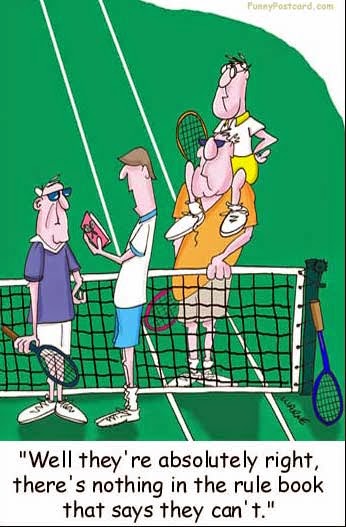
Have you ever been in a middle of a match when something so off the wall happens where both you and your opponent wonder, how do we rule this? Well we've experienced a handful of these odd-ball scenarios and have the USTA sanctioned rulings on each of them to keep you on your toes and to make you into an on-court know-it-all!
  1. What if somebody serves out of order? If you realize a doubles team had served out of order after the fact, then the match continues on in the corrected original rotation of servers. If you make this discovery during a game then immediately stop play and make the correction, then continue the game as is. Regardless of who was serving, all completed points stand as played previous to the discovery. 
  2. What if the ball bounces back over the net before I could hit it? If the spin or wind brings the ball back over the net, then you must hit the ball in order to win the point even if that means reaching over the net to put the shot away. If you fail to touch the ball, then the player who hit the spin shot wins the point. Just be careful not to touch the net or your opponent's side of the court or you lose the point!
  3. What if the ball falls out of my pocket/skirt, do I lose the point? Not necessarily. In regular match-play without tournament officials, it is up to the opponent to call the hindrance and play a let (not you). The call has to be made immediately though, not after the point is played out. If an umpire is present, they will always call a let first. If a ball repeatedly falls out of your pocket, then you may lose a point over the hindrance.
  4. What if the ball hits my racquet twice? As long as you are hitting the ball twice on the same swing or follow-through, it is then (and only then) considered legal. 
  5. What if my strings break on a serve, is that a let? If your strings break during a serve or any other time during a point, it is not a let for anybody. Even if it makes a funny and distracting noise, plan to play out the point even with a hole in your racquet. 
  6. What if the opponent calls a ball of mine Out before it hits the ground, but then yells Good and tries to continue playing out the point? If an Out call was made (and not in the sense of communicating to a partner) then play has stopped. So in this case your opponent would lose the point. And that is exactly why you wait to make a call until after the ball bounces. 
  7. What if you're playing on a court with a dividing net/wall/fence, can you call a Let if the ball hits any of these objects before you hit the ball? Sorry but if all players agree to play on the court as is, all players are agreeing to it's possible hindrances. 
  8. What if an opponent calls a Let on a ball that doesn't actually roll onto our court? Any ball in a player's vision, whether on the other side of the net or near the sidelines, may hinder play during a point so a let is permitted. As long as the let is called prior to the completed point (or before the one calling the let hits the ball), it is considered valid. 
  9. What if I was returning serve when my doubles partner (who was no where near the service box) got clipped on the toe by the server before it bounced. Who gets the point? A ball that hits any part of your body or clothing on you or your partner (on and off the court), is considered a point won by the other team. This is also true if the ball hits any part of you other than your racquet and bounces back over the net. The point is still your opponents-sorry you got hit!   
  10. What if my opponent hits a volley but his racquet swings over the net, isn't that my point?  As long as he hit the ball before his racquet swung over the net, the shot is considered legal. This can be a hard one to judge unless he's clearly reaching over the net to put the shot away.
To study up on other weird tennis rulings, check out Miscellaneous USTA Rules. You never know when you're going to need it!

Do you have a question or weird scenario that you'd like to know the ruling of? Email us with your question!

*Follow us on Facebook to get a first look at new posts, pictures and on-going events or visit us at towpathtennisshop.com and check out the latest arrivals in the shop!
Friday, January 30, 2015

Newest tennis racquets of 2015 (& why they're so awesome)

Kristianne Bontempo | Towpath Tennis Employee | Online Store Manager
The winter season has always been a busy time for racquet purchases-why you ask? It's the perfect opportunity between the busy high school, summer and USTA seasons to demo a racquet and get comfortable handling it before matches start up again. Also, there's something about the new year that always gets players in the mood for a racquet makeover-new racquet, new game? Well racquet vendors sure seem to think so too as we are now fully stocked with some of the most buzzed about racquets on the market. Here are a few we'd like to highlight which are all available to demo in-house or to purchase at www.towpathtennisshop.com!

Specs
Headsize: 100 sq. in.
Length: 26.8"
Beam Width: 27/22.5/21mm
Weight Strung: 270g/(9.5 oz.)
Racquet/Player Type: Beginner-Intermediate
Color(s): Blue/Navy/Coral
Composition/Construction: Graphite/Graphene XT
String Pattern(Mains X Crosses): 16 x 19(standard) or 16 x 16
Recommended String Tension: 48-57 lbs.
Balance: 34.5cm/(13.6 in.)
Grommet Technology: ASP (Adaptive Stringing Pattern)-Racquet comes with 16 x 16 grommets installed.
Frame Technology: Graphene XT
Grip Type: Hydrosorb Pro
Towpath Recommended String: Head Hawk Touch

What's so special about it?
The Graphene XT technology. It increases the weight in the top of the frame to the handle in order to provide better energy transfer, increased swing weight and a higher sweet spot for more power. It also features your choice of string pattern. 16x16 grommets provide more spin and power, or if you want more control and feel pop in the 16x19 grommets.

Why do we like it?
Versatility! The Head Graphene XT Instinct Rev Pro is not only lightweight with a uniquely smaller length to increase stroke speed, but this tennis racquet accommodates to your playing style by providing TWO string patterns! Its selling features make this racquet very maneuverable for beginners, intermediates and up-and-coming juniors. Try the series! Head Graphene XT Instinct S is slightly heavier with a standard length and string pattern, but is still a great option for beginner-intermediate players. The Head Graphene XT Instinct MP is slightly heavier than the Instinct S and was built with the intermediate-advanced player in mind. Did we mention it's Maria Sharapova's racquet of choice! 


Specs
Headsize: 100 sq. in
Length: 27"
Beam Width: 23.5/26/23mm
Weight Strung: 317.5 g/(11.2 oz)
Racquet/Player Type: Intermediate-Advanced
Color(s): Black/White/Blue
Composition/Construction: Graphite 
String Pattern(Mains X Crosses): 16x19
Recommended String Tension: 50-59 lbs.
Balance: 32.89cm/(12.95 in)/4 points HL
Grommet Technology: Woofer
Frame Technology: GT Technology, Cortex Technology, Elliptic Geometry, FSI Technology, EVO BEAM
Grip Type: Syntec Pro
Towpath Recommended String: Babolat RPM Blast 

What's so special about it?
The higher sweet spot! Interesting fact, the Babolat Pure Drive was built based off the data racquet engineers gathered from the Babolat Play racquet, which uniquely tracks your strokes, shot power and impact location of the ball. They began to see a trend where players were hitting much higher on the sweet spot, so what did they do? Duh, raise it! They do this with FSI technology, which also gives players a more responsive contact zone.

Why do we like it?
User-friendly! The Babolat Pure Drive is one of the game's most popular tennis racquets for a reason. It's the perfect balance of power and feel for recreational and competitive players alike who want to improve consistency and depth on all shots. For a lighter more manageable feel, try the series! The Babolat Pure Drive Team and Babolat Pure Drive Lite are great for players looking for pace and spin in a lightweight package. 


Wilson Burn 100SWilson Burn 100S Tennis Racquet

Specs
Headsize: 100 sq. in
Length: 27"
Beam Width: 25mm Dual Beam Width
Weight Strung: 303 g/(10.7 oz)
Racquet/Player Type: Intermediate-Advanced
Color(s): Black/Orange/Lime
Composition/Construction: Carbon Fiber, Spin Effect, X2 Shaft
String Pattern(Mains X Crosses): 18x16
Recommended String Tension: 51-61 lbs.
Balance: 33 cm/(13 in)/4 points HL
Grommet Technology: Parallel Drilling
Frame Technology: Carbon Fiber
Grip Type: Wilson Sublime
Towpath Recommended String: Wilson Revolve 

What's so special about it?
Power! Launched at the Australian Open by tennis professionals Kei Nishikori and Simona Halep, this new line of Wilson racquets is built with explosive power in mind. The Wilson Burn contains a high performance carbon fiber frame, which increases stiffness giving players immense power in their ground-strokes. It also offers a longer handle for more leverage for two-handed backhanders and those with extreme grip changes. 

Why do we like it?
Power! The Wilson Burn was designed to make an impression with base-liners in mind. Built with a bigger, more forgiving sweet spot, this racquet allows players with fast swing types to be aggressive with their shots. The Burn Spin series (100S, 100LS and 100ULS) is equipped with Spin Effect technology which allows players of all levels to produce significantly more spin without changing their swing. The Wilson Burn line will be available to demo or purchase by mid-February. 

These may be the newest racquets of 2015, but don't forget we have over 90 racquet demos for you to try here at the club ranging from Wilson, Babolat, Head, Dunlop, Gamma, Prince, Asics and Yonex. When it comes to racquet selection, speak with our knowledgeable staff about what racquet will suit your playing style best or check us out online to see what we have in stock. Happy playing!

*Follow us on Facebook to get a first look at new posts, pictures and on-going events or visit us at towpathtennisshop.com and check out the latest arrivals in the shop!


Thursday, December 18, 2014

How to finish strong and win in tennis

Dallas Aleman & Kristianne Bontempo | Towpath Tennis Contributors

Many a times you find yourself ahead in a match only to see it squandered away after thinking you had it in the bag. If this is a pattern or an entirely new challenge you're facing, you're not alone! Even the best pros on tour find themselves in total control of a match only to be bewildered moments later when they realize it's slipping from their grasp. Finishing strong means playing smart, and these following lessons will show you how to do just that! 
Lesson #1 - Never make assumptions. We hear it all the time, "He's under-rated," "I've beat her before," or "They have a bad match record." Statistics and past matches say very little on what's happening in the moment.  
Losing a match you thought you'd win can be 
incredibly discouraging.
"After losing to players I've beaten in the past or when struggling against an opponent others write off as beatable, I used to get angry and upset at myself at how 'crappy' I played. The lesson I eventually learned is to pay attention to what your opponent is doing different, instead of what you're NOT doing."
Lesson #2 - Stay focused! It can be incredibly discouraging when you're big lead becomes a neck and neck battle, but the most important part of being a good competitor is to stay focused in the moment. Even if you're up a set and 5 games, play each point as a new point and one that has to be contested. You must win that one, because taking a breather and relaxing just a bit could be the nail in the coffin.   
"I had a saying when playing a tough match and having problems. I would call out, “climb the mountain,” and remind myself to take one step, or in this case point at a time." 
Lesson #3 - Be a good sport and be prepared for the next match. We often take matches for granted, especially when we're not taking our opponents seriously. If you don't finish strong the first time around, make sure you're prepared to give it your all the next time out. Also, whether you win or lose give your opponent some credit. After all, they were able to finish strong against a tough player like you!
“Commenting on the opposite end of the stick, I once played a match where my team was in last place and my partner was under-rated (a 'sure win' for any opponent), but that day we were on fire and battled to a victorious win! Unfortunately, our opponents didn't see us as comparable competitors (and made sure to make note of it), and stormed off the court embarrassed and unjustified. That kind of unsportsmanlike behavior had taken a hit on my self-esteem, but I keep reminding myself that we played great tennis and finished incredibly strong whereas for our opponents--sore losers!"
*Follow us on Facebook to get a first look at new posts, or visit us at towpathtennisshop.com for shoes, racquets and tennis gifts!


Tuesday, November 18, 2014

How to create a winning tennis team

Kristianne Bontempo | Towpath Tennis Employee

It's been a few weeks since our last post, but all for good reason. With a busy fall USTA season winding down as well as one of our own, Natalie Aleman, recently getting married, we want to take a moment to congratulate our 6.0 Mixed 40 & Over tennis team, who just returned from a valiant effort at this past weekend's USTA National Championships in Surprise, AZ! We applaud each and every member on this team because we know it's not easy to get to the National stage given all the blood, sweat and tears involved in the road to victory (even if those tears were from laughter), it's still a huge feat. This isn't the first time a Towpath team has made it to Nationals and hopefully not the last, so we were inspired to share with you our recipe to creating a winning tennis team.

The Towpath 40+ Mixed 6.0 team with (back row) Tom and Amy Haught, Angie Remen, 
Bill Fox, Kip Kuebler, Susan O'Connell, Adam and Cathy Stopka, (front row) Tracy 
Campbell, Ron Novak and captain Michelle Fox. 
  1.  Be committed - The first step to victory is simply committing to your team. You might not realize it but a winning team is formed at the start of each season. When you have reliable teammates who show up whenever the lineup dictates, then you're already ahead of the game. What's also great about readily available teammates is you don't need a lot of them, which means you can strengthen partnerships and experiment with winning lineups. Lastly, commit to believing you will make it to post-season. Don't waste your efforts during the season only to be short players when the team is truly put to the test.
  2. Have a common goal - What do you want to accomplish with this team? Was this team created with playoffs in mind? Are you just getting some quality playtime in? Or do you just want to have fun with your buddies? Get your team on the same page from the beginning and communicate with them along the way. Who knows a team that you created just for fun may find themselves on the path to playoffs, so goals may change. But just because your goals change doesn't mean your strategy should change. If 'playing for fun' is working for you, then by all means stick with it!
  3. Play fair - It's tempting to always play your favorite lineup, but to avoid disgruntled teammates it's best to share playtime among the entire team. This is the time when you need to trust your teammates to do their best and not get disgruntled with them. It's a lot more fun to win as a team than to win thanks to a few token players.
  4. Build camaraderie - Team practices, post-match get-togethers, carpooling to matches, team dinners-these are all perfect opportunities to bond with your teammates. You don't all have to be the best of friends, but the support and confidence some teammates have for one another is uncanny. Plus, there's nothing better than winning with people you care about! 
  5. Have fun, have fun, have fun! - Is that sinking in yet? The pressure to win can take its toll on team morale, which could easily dismantle all your hard-playing work. Getting to playoffs and beyond is a thrill when teammates aren't bickering about losses or bad-mouthing the captain's lineup choice. Stay positive (even if you have to fake it) and celebrate each success, however big or small. If you've made it this far we know you're competitive and here to win, but it's most important to enjoy yourselves along the way!
*Follow us on Facebook to get a first look at new posts, pictures and on-going events or visit us at towpathtennisshop.com and check out the latest arrivals in the shop!

Thursday, October 16, 2014

Top 5 stretches for tennis

Kristianne Bontempo | Towpath Tennis Employee | Online Store Manager

How many times do you get off the court only to realize you forgot to stretch? Stretching is absolutely key to preventing an injury, encouraging elasticity and flexibility and most important, helping you become a better tennis player. We know it's unrealistic to ask you to stretch every little muscle we use while hitting, so here are the top 5 stretches you can't play without. 

For every stretch, hold for at least 30 seconds.


Forearm - This stretch doesn't prevent tennis elbow, but it certainly helps minimize any pain associated with it by loosening up the surrounding tendons and ligaments. Simply stand up straight and keep your arm perpendicular to your body while pushing your hand towards your chest. You should feel stretching along the top of your forearm. You can reverse the stretch, with your fingers toward the sky and your palm facing out. 

Shoulder - We exert tremendous pressure on our shoulders when playing tennis, so this is a very important stretch that will help prevent a strained muscle or tear. Stand straight and cross your arm over while maintaining a straight line. Push your arm toward your chest. You should feel stretching on the topside of your shoulder. Next grab your racquet and with the same grip you swing with, pull the head with your other hand. This will stretch along the underside of your shoulder as well as your bicep. After you finish with one arm, make sure you stretch the other in the same fashion.


Back - I know when I get off the court, the next day my back is reeling if I forget to stretch. Your back is the glue that holds everything together, so stretching is a must! Cross your right leg over your left and slowly reach for your toes while looking at your knees--not the floor. You will feel stretching from your lower back all the way to your neck muscles. Reverse by crossing your left leg over your right. If you have time, stand with both feet side by side and reach down. 

Ankle - Did you know the ankle is one of the most common tennis injuries? This is because it can occur in just one mis-step. You can have the right shoes and a brace, but you shouldn't ignore the fact that a good stretch is the best preventative to an ankle roll. Stretch along a fence or court post to help loosen your achilles tendon, as well as stretch your calf muscle. Also, try slowly rolling your ankle onto its side.


Quad - Our knees take a lot of pressure when sprinting side to side on the court, not to mention constantly stopping short and changing direction. But how exactly do you stretch a knee? Focus on the quad! This stretch targets the thigh muscles, knee and hip joints. Hold your foot behind you and use opposite arm out in front to keep your balance or use the net for support. You'll feel stretching mainly along your quadriceps but by leaning slightly forward/backward, it'll extend to your hip and knee.


Stretching is ideal when your muscles are warm so try moving around a little by doing a short jog, run in place, or wave your arms in circles. If you're really pressed for time and running in late for a match (you know who you are), then the least you can do is stretch these muscles in between games or after the match. The next time you walk off the court without stretching remind yourself, 'This will make me a better tennis player', and drop your bag and stretch! 


*Follow us on Facebook to get a first look at new posts, pictures and on-going events or visit us at towpathtennisshop.com and check out the latest arrivals in the shop!